Andrew Sullivan links to this compilation of Steadicam shots.
Yes, the Steadicam's invention in 1976 revolutionized cinema forever. But there is a little-known fact about Garrett Brown, the genius inventor of the Steadicam... and no, it's not that he also invented the Skycam, an aerial camera rig that produces swooping shots, mainly for sports events.
Garrett Brown is also a remarkable voice talent. With his wife, Anne Winn, he has recorded some very funny radio commercials, nearly always in the genre of romantic comedy. Take a listen at their site. Start with the Amex or the Molson commercials.
Monday, July 7, 2008


Saturday, July 5, 2008
Assuming What's False
It has been said that Barack Obama is shifting positions on Iraq in order to move to the middle.
There's two things wrong with this statement. Obama hasn't been shifting his position on Iraq, but also... he's already right smack in the middle of American public opinion.
Here's some recent polling:
There's two things wrong with this statement. Obama hasn't been shifting his position on Iraq, but also... he's already right smack in the middle of American public opinion.
Here's some recent polling:
CNN
"If you had to choose, would you rather see the next president keep the same number of troops in Iraq that are currently stationed there, or would you rather see the next president remove most U.S. troops in Iraq within a few months of taking office?"
Keep Same Number: 33%
Remove Most: 64%
Time
"Do you believe that the United States should bring most of the troops home from Iraq in the next year or two, or should the U.S. wait until Iraq is relatively stable, even if it takes four years or more?"
In the next year or two: 56%
Wait Until Stable: 39%
LA Times/Bloomberg
"In your opinion, should the United States withdraw troops from Iraq right away, or should the U.S. begin bringing troops home within the next year, or should troops stay in Iraq for as long as it takes to win the war?"
Withdraw Right Away: 25%
Withdraw Within a Year: 43%
Stay as Long as it Takes: 26%
The conservatives critics of Obama who label him a political opportunist for allegedly changing his position have got it wrong; if he were to do so, he would either be an electoral dunce or a paragon of political courage.
Wednesday, July 2, 2008
The Issue No One Is Talking About
If John McCain is elected he will be the oldest U.S President to begin his first term. At 72 years of age, he will be 3 years older than Ronald Reagan was in January 1981.
While this fact is often joked about, the media has not made a systematic exploration of what this means. This paper puts the incidence of Alzheimer's in someone as old as John McCain would be by the end of his first term at around 3.3%. Another study shows that about 22% of people over 71 suffer from cognitive impairment without dementia. Add these numbers together, and statistically there is a better than one if four chance that John McCain will suffer some sort of significant mental decay over the next four years. There is already plenty of anecdotal evidence that McCain's powers might already be diminishing:
Of course, there are other problems associated with advancing age: stamina diminishes and susceptibility to disease and injury increases. While McCain is a very peppy septuagenerian, he has suffered from melanoma, a form of skin cancer, and he has a variety of injuries from his Vietnamese captivity that could become chronic pain problems.
The Presidency is a tough job for even a young, healthy person. Famously, we have seen how the office ages its occupants. Can John McCain afford to hit the fast forward button? Or is it ageist to even ask?
I would argue that senior citizens should be offered the opportunity to do the same jobs younger Americans do. The Presidency, however, is a different matter because it is a job of unique and paramount importance, and because it entails a 4-year term. Many Fortune 500 companies force their CEOs to retire at 65, and I suppose they have good business reasons to, but if a CEO's intellectual powers are lost the board could fire him. We'd likely be stuck with a diminished leader. Under Amendment 25, power can be transferred to the Vice President only with the express consent of the President, or if the President is "unable to discharge" his duties, then with a majority vote from the cabinet. It seems quite plausible that a spirited man like McCain might hold on to office, despite the decay of his powers, and it seems implausible that a cabinet of the President's most ardent loyalists would take this power away from him.
So why won't the media discuss this legitimate issue? They don't think it's polite.
They need to be prodded. Once the issue is in the ether, the media will have an excuse to be impolite, which they love to do because it is provocative and good for ratings. Medical experts will be called on to testify on every cable news show, the newsmagazines will pen long thumbsuckers, and people will think about their own experiences with people over 70 and make up their own minds. The Obama campaign would have to be crazy not to bring this up, and I think they will. The trick is to inject the question into the national debate without alienating older voters. I would suggest that Howard Dean would be the perfect surrogate, both because of his medical background and because he's not running for anything. Obama can then issue a soft denial like "this is an issue that voters have to decide upon, not me, but John McCain certainly seems like an energetic guy."
While this fact is often joked about, the media has not made a systematic exploration of what this means. This paper puts the incidence of Alzheimer's in someone as old as John McCain would be by the end of his first term at around 3.3%. Another study shows that about 22% of people over 71 suffer from cognitive impairment without dementia. Add these numbers together, and statistically there is a better than one if four chance that John McCain will suffer some sort of significant mental decay over the next four years. There is already plenty of anecdotal evidence that McCain's powers might already be diminishing:
Of course, there are other problems associated with advancing age: stamina diminishes and susceptibility to disease and injury increases. While McCain is a very peppy septuagenerian, he has suffered from melanoma, a form of skin cancer, and he has a variety of injuries from his Vietnamese captivity that could become chronic pain problems.
The Presidency is a tough job for even a young, healthy person. Famously, we have seen how the office ages its occupants. Can John McCain afford to hit the fast forward button? Or is it ageist to even ask?
I would argue that senior citizens should be offered the opportunity to do the same jobs younger Americans do. The Presidency, however, is a different matter because it is a job of unique and paramount importance, and because it entails a 4-year term. Many Fortune 500 companies force their CEOs to retire at 65, and I suppose they have good business reasons to, but if a CEO's intellectual powers are lost the board could fire him. We'd likely be stuck with a diminished leader. Under Amendment 25, power can be transferred to the Vice President only with the express consent of the President, or if the President is "unable to discharge" his duties, then with a majority vote from the cabinet. It seems quite plausible that a spirited man like McCain might hold on to office, despite the decay of his powers, and it seems implausible that a cabinet of the President's most ardent loyalists would take this power away from him.
So why won't the media discuss this legitimate issue? They don't think it's polite.
They need to be prodded. Once the issue is in the ether, the media will have an excuse to be impolite, which they love to do because it is provocative and good for ratings. Medical experts will be called on to testify on every cable news show, the newsmagazines will pen long thumbsuckers, and people will think about their own experiences with people over 70 and make up their own minds. The Obama campaign would have to be crazy not to bring this up, and I think they will. The trick is to inject the question into the national debate without alienating older voters. I would suggest that Howard Dean would be the perfect surrogate, both because of his medical background and because he's not running for anything. Obama can then issue a soft denial like "this is an issue that voters have to decide upon, not me, but John McCain certainly seems like an energetic guy."
Saturday, May 24, 2008
Why My Neighborhood Is the Coolest
According to the U.S. Census, Queens is probably the most diverse county in the U.S. With nearly half of its population born overseas, it comes a close second to Miami-Dade in the percentage of foreign-born residents, but Miami-Dade is predominantly Latin and Cuban whilst the population in Queens comes from more than 100 nations. Some populations concentrate in certain neighborhoods: Flushing, for instance, is predominantly Asian. Other neighborhoods like Astoria, where I live, and Jackson Heights not far away, have residents from many countries and would probably have a good claim to be the most diverse neighborhoods in the world.
Today I went to my greengrocer. The produce is about half as cheap as the Korean convenience store just a couple of blocks away, and about a third as cheap as Manhattan. The place is owned by a Greek. Central Americans work the produce, and pretty young girls from many different nationalities work at the cashier. The Brazilian girl who flirts with every male between the ages of 12 and 80 wasn't there today, so I got in another line. Pretty soon I was at the head, and there was an elderly man next to me in traditional Arab garb. "Did you get this from inside or outside?" asked the girl at the cashier. He couldn't understand what she was asking. The Greek girl next to her intervened; they tried with sign language to explain what they were asking, but it wasn't getting through. "I do not understand," he said. Finally, they just laughed and charged him the lower price.
Then, the first girl asked: "are you Muslim?" The old man understood this. He answered that he was. This very European-looking girl placed a hand over her heart and said "I am Muslim."
The Arab man smiled. "Yarhamkom allah" he said. "Yarhamkom allah" she replied. For my benefit, he turned and managed to communicate that this was how a muslim greeted a muslim. It meant 'God Bless You'. "That is all the Arabic she knows" laughed the Greek girl. "I know, I know" said the other girl, as if knowing only this much Arabic were a grave personal shortcoming. The Arab man asked where she was from; it turns out that she was from Kosovo. And that is where I left them. I walked away with the makings for an excellent salad and a smile on my face.
We all get along in Astoria. We're all after the same very American goal: to make a little bit better lives for ourselves and our kin. We're new to America, but we are the soul of America. We are the future of America. I will never understand the people that are frightened by otherness. I find it exhilarating.
Today I went to my greengrocer. The produce is about half as cheap as the Korean convenience store just a couple of blocks away, and about a third as cheap as Manhattan. The place is owned by a Greek. Central Americans work the produce, and pretty young girls from many different nationalities work at the cashier. The Brazilian girl who flirts with every male between the ages of 12 and 80 wasn't there today, so I got in another line. Pretty soon I was at the head, and there was an elderly man next to me in traditional Arab garb. "Did you get this from inside or outside?" asked the girl at the cashier. He couldn't understand what she was asking. The Greek girl next to her intervened; they tried with sign language to explain what they were asking, but it wasn't getting through. "I do not understand," he said. Finally, they just laughed and charged him the lower price.
Then, the first girl asked: "are you Muslim?" The old man understood this. He answered that he was. This very European-looking girl placed a hand over her heart and said "I am Muslim."
The Arab man smiled. "Yarhamkom allah" he said. "Yarhamkom allah" she replied. For my benefit, he turned and managed to communicate that this was how a muslim greeted a muslim. It meant 'God Bless You'. "That is all the Arabic she knows" laughed the Greek girl. "I know, I know" said the other girl, as if knowing only this much Arabic were a grave personal shortcoming. The Arab man asked where she was from; it turns out that she was from Kosovo. And that is where I left them. I walked away with the makings for an excellent salad and a smile on my face.
We all get along in Astoria. We're all after the same very American goal: to make a little bit better lives for ourselves and our kin. We're new to America, but we are the soul of America. We are the future of America. I will never understand the people that are frightened by otherness. I find it exhilarating.
Thursday, May 1, 2008
McCain: No Holiday From Pandering
John McCain's proposal for a gasoline tax holiday is getting some harsh reviews, including from some conservative economists.
McCain has admitted to a lack expertise about economic matters, but this proposal betrays something different: either a cynical contempt for the electorate, or an abject economic illiteracy.
It comes down to the basic laws of supply and demand. If the tax from gasoline is removed for three months, the price will go down. Yippee! But as any student of Economics 101 will know, demand will spike in response. And what happens when supply is fixed, as gasoline in the summer is, both because of flat crude oil production and limited refinery capacity? The price goes back up until supply and demand are in balance again.
But suppliers will ramp up production to make up for it, right? No. A temporary tax cut, announced with a few weeks of anticipation, is not going to get new refineries online for the summer.
When Obama says the tax cut will on average only save consumers $30 over three months, he's actually being too generous. The best guess is that it will be less than that, if anything at all. And this comes at the cost of our crumbling highway infrastructure, since that is where the revenue from the gas tax is dedicated.
McCain's tax cut will go straight into the pockets of the oil companies, not into the wallets of our strapped consumers.
Is Hillary Clinton's plan to fund the tax cut with a windfall profits tax on oil companies preferable? Let me hand it over to Leonard Burman, director of the Tax Policy Center:
McCain has admitted to a lack expertise about economic matters, but this proposal betrays something different: either a cynical contempt for the electorate, or an abject economic illiteracy.
It comes down to the basic laws of supply and demand. If the tax from gasoline is removed for three months, the price will go down. Yippee! But as any student of Economics 101 will know, demand will spike in response. And what happens when supply is fixed, as gasoline in the summer is, both because of flat crude oil production and limited refinery capacity? The price goes back up until supply and demand are in balance again.
But suppliers will ramp up production to make up for it, right? No. A temporary tax cut, announced with a few weeks of anticipation, is not going to get new refineries online for the summer.
When Obama says the tax cut will on average only save consumers $30 over three months, he's actually being too generous. The best guess is that it will be less than that, if anything at all. And this comes at the cost of our crumbling highway infrastructure, since that is where the revenue from the gas tax is dedicated.
McCain's tax cut will go straight into the pockets of the oil companies, not into the wallets of our strapped consumers.
Is Hillary Clinton's plan to fund the tax cut with a windfall profits tax on oil companies preferable? Let me hand it over to Leonard Burman, director of the Tax Policy Center:
Burman called this "utterly incoherent," saying that a windfall-profits tax would over the long term only exacerbate the supply problems caused by lifting the gas tax, because it would discourage the exploration for and development of new sources of petroleum. "So a policy intended to lower prices, but which won't do that, will be offset with a policy that's likely to raise prices over the long term," he said.
In his campaign we keep on going back to character issues. Rather than fixate on trivia, we should look at what the candidate's policy proposals tell us about them... both as leaders and as people.
Sunday, April 20, 2008
Reading Sideways
It's by no means an original observation to say that the way we read text influences the way we read an image. In western countries we tend to scan an image from the top left to the top right, then bottom left to bottom right. (I have written about what this means practically in another post. Nickel version: it's not about the importance of any particular area of the image -- it's about how we interpret motion, force and intention.)
So as one friend asks... what does this mean for the images of cultures that don't read from left to right?
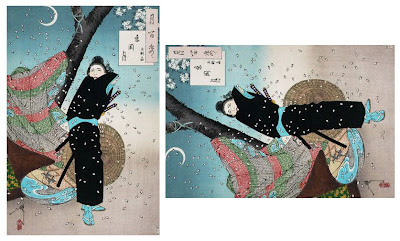
The Japanese writing system starts from the top right and goes to the bottom right, then across the page from right to left. This allows for a marvelous experiment. If we turn a japanese print counter-clockwise by 90 degrees we would then scan the image in much the same way a Japanese reader/viewer would. Does this allow the image to make more sense to us? I think so.
This is a woodblock print, probably from the 19th century. Unfortunately, I cannot credit the artist (click to enlarge.)
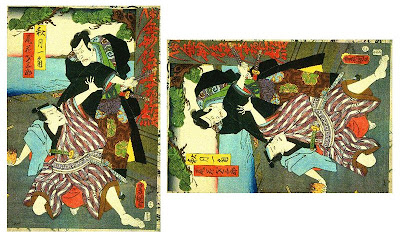
Notice how much more dynamic the image looks when it is turned sideways. The figure with the sword looks far more dominant; the sitting figure much more helpless. The eye races over the stripes in the defeated man's robe like they were highways. The yellow-red pattern on the swordsman's costume looks flat when the image is upright, infused with action when the print is turned. The lake on the left seems inert; when the print is turned, it looks plaintive and peaceful.
This is another 19th century print (click to enlarge):
Notice how the cherry blossoms seem to fall more convincingly at right. The gradient background seems more foreboding. And most notably, on the left he seems to be weirdly off-balance; when the print is turned, he seems more like he's bracing himself against the elements... a major one of which seems to be the direction of the viewer's eye.
Update: Here's an insight that came about from the interplay in comments. In Western art the signature of the artist is usually in the last quadrant the reader would see, the lower right... just how you would sign a letter at the end, not at the beginning or middle. In a Japanese work, one would expect it to appear in the lower left, since that is the last quadrant a Japanese reader would see. And indeed, that is where these pieces I show are signed.
I'm convinced!
So as one friend asks... what does this mean for the images of cultures that don't read from left to right?
The Japanese writing system starts from the top right and goes to the bottom right, then across the page from right to left. This allows for a marvelous experiment. If we turn a japanese print counter-clockwise by 90 degrees we would then scan the image in much the same way a Japanese reader/viewer would. Does this allow the image to make more sense to us? I think so.
This is a woodblock print, probably from the 19th century. Unfortunately, I cannot credit the artist (click to enlarge.)

Notice how much more dynamic the image looks when it is turned sideways. The figure with the sword looks far more dominant; the sitting figure much more helpless. The eye races over the stripes in the defeated man's robe like they were highways. The yellow-red pattern on the swordsman's costume looks flat when the image is upright, infused with action when the print is turned. The lake on the left seems inert; when the print is turned, it looks plaintive and peaceful.
This is another 19th century print (click to enlarge):

Notice how the cherry blossoms seem to fall more convincingly at right. The gradient background seems more foreboding. And most notably, on the left he seems to be weirdly off-balance; when the print is turned, he seems more like he's bracing himself against the elements... a major one of which seems to be the direction of the viewer's eye.
Update: Here's an insight that came about from the interplay in comments. In Western art the signature of the artist is usually in the last quadrant the reader would see, the lower right... just how you would sign a letter at the end, not at the beginning or middle. In a Japanese work, one would expect it to appear in the lower left, since that is the last quadrant a Japanese reader would see. And indeed, that is where these pieces I show are signed.
I'm convinced!
Saturday, April 5, 2008
The Phony Balance (Or The Real Reason We Need to Leave Iraq)
Publius argues that there is some moral hazard to staying in Iraq:
Here, the overriding risk is all-out civil war – whether inter-or-intra ethnic group – or regional war, or both. Our presence mitigates these risks – at least in the short term. Thus, Maliki can take risky actions like raiding Basra or openly turning the army into a wing of Badr, knowing that he and his allies won’t be exposed to the full risk of those actions (civil war) because of the American presence.
Publius is part of a school of thought which argues that we're allowing the Iraqi government to avoid the difficult choices required to reconcile Iraq. Our departure, they optimistically say, will spur the Shiites to make the compromises necessary for the government to survive. Now, we've used every other kind of leverage there is to prod the Shiite leaders of Iraq to share their power with Sunnis, and none of them have worked. Perhaps using withdrawal as leverage might have an effect, and it certainly can't hurt to try... but I have my doubts.
Maliki's problem is not being too ready to take risks; it is negotiating between multiple risks. For Maliki, not raiding Basra would be a risk as well. He is caught between the sword of the Sunnis and the sword of the more radical Shiite elements. The U.S. disengagement will certainly push him to make choices, but it won't make either sword less sharp, and it won't improve his ability to split the difference, if that's even politically possible for him. Yes, the U.S. is protecting him from Sunni insurgents, but as Basra shows, it's also protecting him from recalcitrant elements of the Shiite faction. The risk from both sides would grow, and it's hard to see how his ability to negotiate the risks would improve.
I would be glad to be surprised, but I don't think our departure would hasten reconciliation in Iraq. What I would argue -- and emotionally it's a more difficult argument to accept -- is that our departure might make things worse in the short run, but that it would allow Iraq to find its own balance faster. And that a strong Iraqi government is simply not possible under a U.S. military occupation.
Every day we stay in Iraq, we cheat the government there of legitimacy. While Iraq is under occupation, Iraqis will always see their government as a handmaiden to the U.S., rather than a representative of them. Elections are fine, but when elected officials seem circumscribed by a foreign invading army, those elections lose their power to confer legitimacy.
Machiavelli said the prince needs to be either loved or feared, and that it was easier to be feared. Unfortunately, we're not making it easier for the Iraqi government win either kind of respect. Even if the Iraqi military were a crack force (and Basra casts that in doubt,) they will not be able to prove that they can hold the country together while the U.S. is still there. Until big brother steps away, the neighborhood bullies are all going to suspect they can take on little brother. The consequences for the outcome of the Sunni-Shia struggle are clear: insurgencies are over when one side knows it has lost. The Sunnis will not know they've lost until the U.S. leaves and they still cannot win power.
We complicate the government's political position in other ways: since the government has to cater to a constituency of American generals and officials, it is less able to freely develop its own Iraqi-grown constituency. Moreover, the commitments of the government when negotiating with Sunnis are doubted, because it is not known how long the U.S. will stay, and it is not known which of those commitments were made under American influence.
Finally, we need to recognize that a small but significant portion of the total violence in Iraq is not aimed at Sunni or Shia, but by nationalists against a foreign encroacher, or by jihadists against a nation of infidels. It is in our power to remove that violence by removing the irritant that causes it: ourselves.
While we support it with the force of our arms, the Iraqi government will always be a cripple in a body cast, with its muscles atrophying inside. The body cast needs to be ripped off. Then we will know if it will strengthen its muscles and survive, or perish and be replaced by something else.
We can kid ourselves into thinking that our presence is calming the water, but we're just delaying the accounting. Putting Sunni insurgents on our payroll might quell the violence momentarily, but it does not quench their aspirations, and it runs the danger of strengthening their cohesiveness and organization.
You can put a thumb on either side of the scale and pretend that it has come to balance, but it hasn't. It's a phony balance. We need to take our thumbs off the scale and let Iraq find its own equilibrium; we need to let Iraqis solve their own problems. We can and should withdraw in a cautious manner that would maximize the government's chances for survival and minimize the odds of a donnybrook. But we also need to cast off our illusion of omnipotence and stop pretending we can doctor a culture we barely understand.
Subscribe to:
Posts (Atom)